 |
 |
|
SEASONS
OCCASIONAL SERVICES FOR:
CHURCHES
PASTORS
BISHOPS +
RENEWING THE
CHURCH
ABOUT THE
AUTHOR
DONATIONS |
|
Saints Alive!
by The Rev. Thomas L. Weitzel
Evangelical Lutheran Church in America
"Saints Alive!" is a
really fun, yet reverent, celebration of saints of old and saints alive, with a
particular emphasis on seeing ourselves in the lives of the holy and
occasionally not-so-holy saints. It is basically a narrative interspersed
with praise, scripture, song and prayer. It has something of a pageant
quality to it, in that people are encouraged to come costumed as their favorite
saint (especially kids). Whether they are used in a "show and
tell" manor with the narration or asked to do anything else is up to the
imagination of those who put this event together. Photos, banners, art,
sculpture, etc. of the saints are also encouraged.
Aside from the Narrator and
costumed saints, there are two lessons that can be read by one or two Lay
Readers. A separate person might also do the Leader (L) parts of the
worship sections, or the narrator can do this.
As for the saints treated below,
they were picked from among the churches with saints' names in the Indianapolis
Conference ELCA, along with a few other of their favorites, for their Fall
Conference Assembly, Nov. 4, 2001, where "Saints Alive!" was first used.
Clearly other saints can be substituted in the text. However, a
note of caution: As you will note in the text below, I was very
intentional in drawing out the human qualities of each saint – if not their
known sins, at least their foibles ("halo tipping" as I call it in
the text) – in order to show how ALL God's saints are sinners, being holy one
moment and not always so holy the next. "Saints Alive!"
undergirds the faith of saints in the pews in their call and vocation to be the
saints of the church today.
Two handouts should be prepared
from the text below, minus the instruction to read just the paragraph headings:
"Biblical Definition of a Saint" and "The Bible's Job
Description of a Saint." These may be printed on two sides of
one sheet.
"Saints Alive!" is about 1:15 hr. in length as it is currently written. Adjust for any changes or additions you might make to the treatment of saints in the narrative. Plan to enjoy yourselves!
1. OPENING
HYMN: "Shall We Gather
by the River"
DIALOG FOR ALL SAINTS:
L. Praise the Lord, all you saints!
C. Praise him all you heavenly hosts!
L. Let us praise the name of the
Lord:
C. For his name only is exalted!
L. Abraham, Isaac and Jacob:
C. Isaiah, Jeremiah and all you Patriarchs and Prophets!
L. Miriam, Ruth and Naomi:
C. Elizabeth, Mary and all you Holy Women!
L. Matthew, Mark and Luke:
C. James and John and all you Evangelists and Apostles!
L. Stephen, Thomas, Peter and Paul:
C. Philip, Bartholomew and all you Holy Martyrs!
L. Praise the Lord!
C. O praise the name of the Lord!
L. These are the saints whose robes
are washed white in the blood of the Lamb.
C. Praise the Lord!
L. We are the saints who are the
living body of Christ, the Church.
C. Praise the Lord! O praise the name of the Lord!
PRAYER OF THE DAY (for All Saints)
L. The Lord be with you.
C. And also with you.
L. Let us pray. Almighty God, whose
people are knit together in one holy Church, the body of Christ our Lord: Grant
us grace to follow your blessed saints in lives of faith and commitment, and to
know the inexpressible joys you have prepared for those who love you; through
your Son, Jesus Christ our Lord, who lives and reigns with you and the Holy
Spirit, one God, now and forever.
C. Amen
2. WHY DO WE REMEMBER SAINTS?
 NARRATOR:
Why do we remember saints? We are a remembering people. It’s in our
nature to remember and mark our remembering in special ways. By so doing, we
extend beyond ourselves and our time. When significant people touch and impact
our lives, we want to remember them and treat them special – not only when they
are alive, but also after they are dead. Keeping memory alive keeps us alive.
Each memory is a story, and we are part of that story. Remembering is being
linked to something bigger than ourselves.
NARRATOR:
Why do we remember saints? We are a remembering people. It’s in our
nature to remember and mark our remembering in special ways. By so doing, we
extend beyond ourselves and our time. When significant people touch and impact
our lives, we want to remember them and treat them special – not only when they
are alive, but also after they are dead. Keeping memory alive keeps us alive.
Each memory is a story, and we are part of that story. Remembering is being
linked to something bigger than ourselves.
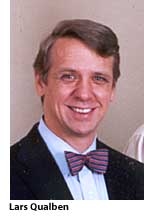
How does it start? It starts with
someone we know, perhaps like this man (photo
1: Lars Qualben). He is like us, a believer
and a Christian like us. Maybe even goes to our own church. Lars Peter Qualben here was a member of Trinity Lutheran Church in
Brooklyn, New York. Or maybe he is our father or brother or husband or son. Or
maybe you don’t even know that much about him, except that he is a Christian
who lives his faith, and you can see it.
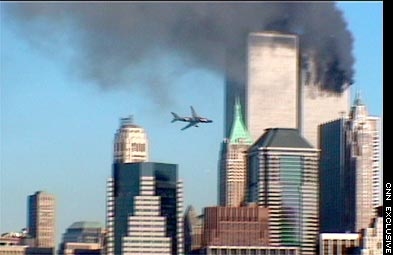 Then
something happens like this (photo 2: World
Trade Center attack & collapse).
Lars was working there on the 100th floor of one of the two towers. Suddenly he
is gone from us. Gone, but not forgotten. We are left numb and empty. Yet our
faith assures and informs us about this person’s fate, because his faith and
Christian witness still impact us and are of cherished memory.
Then
something happens like this (photo 2: World
Trade Center attack & collapse).
Lars was working there on the 100th floor of one of the two towers. Suddenly he
is gone from us. Gone, but not forgotten. We are left numb and empty. Yet our
faith assures and informs us about this person’s fate, because his faith and
Christian witness still impact us and are of cherished memory.
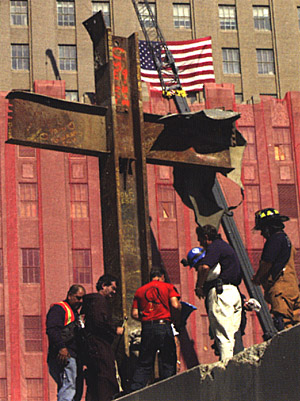
Our
loss moves us to act. We bring flowers to the place he died (photo
3: WTC flowers). We burn candles in vigil with others (photo
4: WTC vigil). We post pictures in common places, like the subway (photo
5: WTC subway). We raise crosses marking our faith and his (photo 6: WTC
cross). And we pray. And others pray with us. And remember. All
these things help us to remember. And we tell stories. And tell more stories.
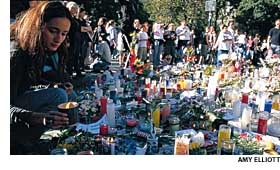 And the stories keep coming. And
the remembering doesn’t die. We heal and move on, but the remembering doesn’t
die. This person’s witness and impact remain for us. And the stories and the
remembering impact others as we tell them, until they too tell the stories and
remember. And they pass it on to someone else, who passes it on to someone
else. Until person by person, generation by generation, the stories and the
remembering are carried to uncountable numbers of people.
And the stories keep coming. And
the remembering doesn’t die. We heal and move on, but the remembering doesn’t
die. This person’s witness and impact remain for us. And the stories and the
remembering impact others as we tell them, until they too tell the stories and
remember. And they pass it on to someone else, who passes it on to someone
else. Until person by person, generation by generation, the stories and the
remembering are carried to uncountable numbers of people.
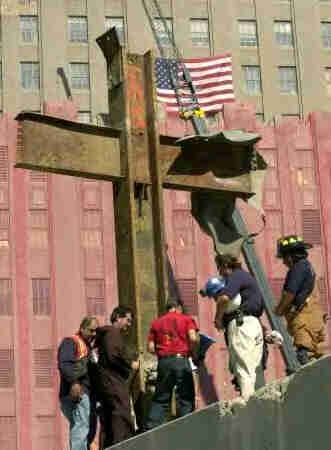 Why should I
tell you the history of marking and remembering the saints in the early
Christian Church when we are living that history right now? We are doing
exactly what they did when early Christians died – whether those Christians
died under persecution or in peace – were martyred for their faith or just died
in their beds.
Why should I
tell you the history of marking and remembering the saints in the early
Christian Church when we are living that history right now? We are doing
exactly what they did when early Christians died – whether those Christians
died under persecution or in peace – were martyred for their faith or just died
in their beds.
We are here in Indianapolis,
Indiana in the United States of America; and today is November 4th in the year
2001 AD, the first year of the presidency of George W. Bush; and we are keenly
affected by recent events of atrocity against innocent people. But we might
just as easily be in Lyons, France, formerly the province of Gaul, in the
Empire of Rome; and it is June 2nd of the year 177 AD, in the 17th year of the
imperial reign of Marcus Aurelius; and we are just as keenly affected after the
recent arrest, torture and horrific slaying of 48 members of our church.
Reports indicate that among the dead are a local nobleman, a foreign laborer, a
doctor from Turkey, a 15 year old boy, a young slave girl, a reclusive old man,
a young man recently baptized, a former slave who converted later in life, a
young deacon serving the neighboring church, and our 90 year old pastor. (You
know, I could be reading this out of the Indianapolis Star.) And what
are we doing this June 2nd, 177? We are numb. We are in shock. We are hurt and
grieving. But we are remembering. And lighting candles. And leaving flowers.
And saying prayers. And telling stories. Faith stories. And passing it on. And
passing faith with it.
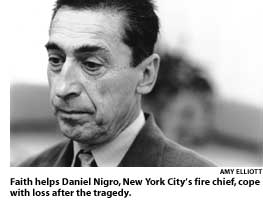 It’s
funny how it is. It starts with regular people, like Lars here. Or like Daniel Nigro here (photo
7: Daniel Nigro), a Christian and member
of Good Shepherd Lutheran Church in Queens, New York. He’s still living out his
faith, and he really needs it right now. He became the new Fire Chief of New
York City after his predecessor died in action on Sept. 11. Daniel was also
there that day, one of the first to arrive. Just another regular guy, a regular
Christian guy, with faith, going into the unknown – going into the unknown even
now as he lives from day to day.
It’s
funny how it is. It starts with regular people, like Lars here. Or like Daniel Nigro here (photo
7: Daniel Nigro), a Christian and member
of Good Shepherd Lutheran Church in Queens, New York. He’s still living out his
faith, and he really needs it right now. He became the new Fire Chief of New
York City after his predecessor died in action on Sept. 11. Daniel was also
there that day, one of the first to arrive. Just another regular guy, a regular
Christian guy, with faith, going into the unknown – going into the unknown even
now as he lives from day to day.
"I don’t know what it would be
like not to have [faith]," he tells us in The Lutheran magazine
(Nov. 2001). "Even while it was going on, I didn’t feel this horrendous
dread. I’d like to think that was because of my faith."
Two regular people, just regular
Christian guys, both doing their jobs, but doing so with faith. They are both
saints of our Church, one alive and one now dead. This is what today is all
about, and this is what we are going to talk about and learn about and
experience here in story, scripture and song.
HYMN: "Faith of Our Fathers"
3.
WHAT MAKES A SAINT?
NARRATOR: What makes a saint?
Faith makes a saint. Faith takes regular guys like Lars and Nigro, regular church people like the Martyrs of Lyons, and
turns them into something special. Faith does that. Faith and baptism. And it
does it fast too! Did you notice one of those killed in Lyons was hardly dry
yet from his baptism?
How does faith and baptism make us
special? By making us holy. Most of you probably already know that the word
saint comes from the Latin sanctus, which means
"holy." Tell me, when you think of holy, who do you think of first?
God! Of course! God is holy. Who could be more holy?
Who else is holy? Jesus is holy. Of
course! If God is holy, then God’s son is holy too. In fact, when we want to
define or determine what is holy, it is always in reference to God, isn’t it?
God is holy, and what God does is holy (Ps.77.13).
Could we also say that what God
makes is holy too? Only up to a point. Certainly Genesis 1 tells us repeatedly
that all that God made is "good." But holiness is something more than
just "good." Holiness is a GIFT when it comes to you and me,
according to the Bible. And what is most interesting there is that God CALLS us
to be holy. God, who is holy in every way, CHOOSES us and CALLS us to himself.
And by choosing us and calling us, God MAKES us holy.
How? That’s where faith and baptism
come in. He makes us holy through faith and baptism. God who is holy joins us
to his holy self. God forgives us, washes us free from sin, clothes us with
holiness and righteousness, and gives us the Holy Spirit to keep us holy
through faith. And in so doing, God gives us salvation. Quite a bundle in that
gift, isn’t it? ALL that, all at once, at our baptisms! We become holy as God
is holy.
That’s what makes us and all
believers saints. In fact, nearly every reference in the Bible to saints is to
living Christian believers like you and me. For Paul and the whole Bible, the
word "saint" and the word "Christian" are INTERCHANGEABLE,
one in the same thing. And if you are a Christian, then you are holy by
definition! That’s why you are a saint, because you are holy.
Trouble is, it’s easy to sit here
in the comfort of this church and feel holy, but just step outside and into
traffic sometime, with the crazies all darting in and out, riding your tail or
cutting you off. THEN how holy do you feel? Does the word "sinner"
come more quickly to mind for you? We can’t deny that we are all sinners. In
fact, we probably know that we are sinners FAR better than we know we are holy,
don’t we? I wonder: do you think maybe this hang up on sin is really out of a
sense of humility? Nah. Probably Lutheran guilt, right?
But if we are believing, baptized
Christians, how could we NOT be holy if we have been made holy by God through
faith and baptism? Listen to Martin Luther on this subject:
"Just as we should not deny that we are baptized and Christians, so we
should not deny or doubt that we are holy.... For when Christians call
themselves holy after Christ, this is not arrogance; it is honor and praising
God." [What Luther Says, #3977.]
So we are saint and sinner, all at
the same time. We are saint, made holy by God’s grace through baptism. We don’t
always act holy, but as God’s people joined to his holiness, we KNOW when we
sin, and we HEAR God’s call OUT of sin to return to holiness again.
Are you beginning to see how we are
not so different from the saints that we call saints? Living or dead, all
saints begin at the same place: at their baptism, at their joining with the
holy God. And when we are joined to the holy God, there is power to BE holy in
ways that might surprise you completely.
I spend this time talking about who
YOU are as a saint before telling those stories of the saints of old, because
if you know who YOU are as a saint, then you can begin to know better what it
was that made the saints of old what they were. They didn’t do it themselves anymore than you can do it yourselves. As you depend on
God, so did they. That’s why it all just comes down to a matter of faith,
doesn’t it? Faith in a God who does great things, with and through us, even to
our own surprise.
So, to know who YOU are as a saint,
let me sum up precisely what the Bible has to say about what a saint is in that
HANDOUT that I have provided you. You can read the scripture passages for yourselves,
but let me read the points they address:
BIBLICAL DEFINITION OF A SAINT (only read bold paragraph headings)
Saints are believers, "in Christ Jesus"
– as Paul says it in so many openings of his letters; and (2 Th.1:10) we will
be there and ready "when Jesus comes to be glorified by his saints and to
be marveled at on that day among all who have believed."
Saints are called – (Rom.1:7) "To all God's
beloved in Rome, who are called to be saints: Grace to you...."
Saints have faith and salvation – (Jude 1.3)
"Beloved, while eagerly preparing to write to you about the salvation we
share, I find it necessary to write and appeal to you to contend for the faith
that was once for all entrusted to the saints."
Saints are inheritors – (Col.1:11-12) "May
you be made strong with all the strength that comes from his glorious power,
and may you be prepared to endure everything with patience, while joyfully
giving thanks to the Father, who has enabled you to share in the inheritance of
the saints in the light."
Saints are members of God’s household –
(Eph.2.19-20) "So then you are no longer strangers and aliens, but you are
citizens with the saints (i.e. other believers) and also members of the
household of God, built upon the foundation of the apostles and prophets, with
Christ Jesus himself as the cornerstone."
Saints are made holy – (1 Cor
1.2) "To the church of God that is in Corinth, to those who are sanctified
in Christ Jesus, called to be saints, together with all those who in every
place call on the name of our Lord Jesus Christ, both their Lord and
ours."
Saints are living – (Acts 9:32) "Now as
Peter went here and there among all the believers, he came down also to the
saints living in Lydda."
Saints are dead – (Mt.27:51-52) "At that moment
the curtain of the temple was torn in two, from top to bottom. The earth shook,
and the rocks were split. The tombs also were opened, and many bodies of the
saints who had fallen asleep were raised."
Saints are from everywhere – (Rev.5:9) "They
sing a new HYMN: "You are worthy to take the scroll and to open its seals,
for you were slaughtered and by your blood you ransomed for God saints from
every tribe and language and people and nation."
So now, are we clear on what a
saint is? And are you ready to hear the stories of the saints – knowing that
what we are about to hear will be stories of FAITH that makes us all saints in
the first place? Good! Then let’s begin by standing and confessing the faith in
which we baptize, the faith in which all saints believe, the Apostles’ Creed:
APOSTLES CREED:
I believe in God, the Father
almighty, creator of heaven and earth.
I believe in Jesus Christ, his only
Son, our Lord. He was conceived by the power of the Holy Spirit and born of the
Virgin Mary. He suffered under Pontius Pilate, was crucified, died, and was
buried. He descended into hell. On the third day he rose again. He ascended
into heaven, and is seated at the right hand of the Father. He will come again
to judge the living and the dead.
I believe in the Holy Spirit, the
holy catholic Church, the communion of saints, the forgiveness of sins, the
resurrection of the body, and the life everlasting. Amen
HYMN: "How Firm a Foundation"
4. WHAT DO SAINTS DO?
NARRATOR: We’ve talked about
what a saint IS, but what does a saint DO? I think we will learn that by
example through the stories of the saints we tell today. But let’s listen to
God’s word in scripture about this first.
SCRIPTURE READING 1: Hebrews 11:1-16
Now faith is the assurance of
things hoped for, the conviction of things not seen. Indeed, by faith our
ancestors received approval. By faith we understand that the worlds were
prepared by the word of God, so that what is seen was made from things that are
not visible. By faith Abel offered to God a more acceptable sacrifice than
Cain's. Through this he received approval as righteous, God himself giving
approval to his gifts; he died, but through his faith he still speaks. By faith
Enoch was taken so that he did not experience death; and "he was not
found, because God had taken him." For it was attested before he was taken
away that "he had pleased God." And without faith it is impossible to
please God, for whoever would approach him must believe that he exists and that
he rewards those who seek him.
By faith Noah, warned by God about
events as yet unseen, respected the warning and built an ark to save his
household; by this he condemned the world and became an heir to the righteousness
that is in accordance with faith. By faith Abraham obeyed when he was called to
set out for a place that he was to receive as an inheritance; and he set out,
not knowing where he was going. By faith he stayed for a time in the land he
had been promised, as in a foreign land, living in tents, as did Isaac and
Jacob, who were heirs with him of the same promise. For he looked forward to
the city that has foundations, whose architect and builder is God. By faith he
received power of procreation, even though he was too old – and Sarah herself
was barren – because he considered him faithful who had promised. Therefore
from one person, and this one as good as dead, descendants were born, "as
many as the stars of heaven and as the innumerable grains of sand by the
seashore."
All of these died in faith without having received the promises, but from a distance they saw and greeted them. They confessed that they were strangers and foreigners on the earth, for people who speak in this way make it clear that they are seeking a homeland. If they had been thinking of the land that they had left behind, they would have had opportunity to return. But as it is, they desire a better country, that is, a heavenly one. Therefore God is not ashamed to be called their God; indeed, he has prepared a city for them.
The word of the
Lord!
C. Thanks be to God!
NARRATOR: The Bible is a
pretty good book for us, isn’t it? It tells us about God and talks a lot about
faith in him, just like in that passage from Hebrews. That’s why the Bible has
often been called the "Book of Faith." Ever thought of the Bible as a
"Book of Saints"? It is. If it’s about faith, then it’s not just a
book about God; it’s a book about those HAVING faith, isn’t it? Lots of them.
The good and the bad of them, as a matter of fact; the holy side and the
not-so-holy side; it’s ALL there in the Bible.
MOSES
Take Moses, for instance (Moses
sculpture). I LOVE to tell the story of Moses. Can you think of anyone
in the whole Bible – excepting Jesus, of course – who is any BIGGER a GIANT of
faith than Moses? None. He is everything that Cecile B. DeMille made him in
"The Ten Commandments" and more. WOW! How can this guy be ANYTHING
like you and me, if we are going to talk about ourselves in terms like saint,
right? Well first, you need to remember that all those miraculous events were
done by GOD, not Moses. As for Moses, just look at the story of his calling in
Exodus 3. It's just a hoot!
God says from the burning bush,
"I have observed the misery of my people who are in Egypt; and I have come
down to deliver them and bring them to a land flowing with milk and honey. So
come, I will send you to Pharaoh to bring my people out of Egypt."
And Moses says, "Who?
Me?" Now doesn't this already sound like you and me?
"Not to worry," says God,
"I will be with you."
Hmmm, Moses doesn't think he likes
this idea at all, so he deflects the conversation AWAY from himself. Ever tried
that when the pastor asks you to do something? "IF I come to the Israelites
on your behalf and they ask what is your name, what shall I tell them?"
God is no dummy, so he answers with
"I am who I am," and immediately turns it BACK on Moses: "This
is what YOU shall say to them. Go and assemble the elders. They will listen to
you."
Moses is still not convinced:
"Suppose they DON’T listen me and believe that my story about running into
you is a bit flakey?" (Clearly, my own translation here, but this really
IS what’s going on.)
Well, God answers by showing him
how it will work with his staff turning into a serpent and his hand becoming
leprous, etc. That should have impressed Moses, you know?
Nope, it didn’t. What's next?
Excuses. Hey, you should have known that! It's what you and I do: "O my
Lord, I am slow of speech and tongue; I have never been eloquent – NOT EVEN
SINCE YOU STARTED TALKING TO ME, by the way." Can you believe the nerve of
this guy?
God bites his tongue and again
says, "Not to worry. I will be with your mouth and teach you what to
speak." Have I mentioned that we’ve crossed over into chapter 4? Yeah,
this was a LONG conversation.
Moses, still not ready to answer
this call, says, "O my Lord, PLEASE send someone else." That’s word
for word, folks, right out of the Bible.
So is this line about God’s
reaction: "Then the anger of the Lord was kindled against Moses." Of
course it was! "Alright!" he says, "I’ll fix it for you. We’ll
let your BROTHER do the talking. I’ll speak to you, and you speak to him, and
he will speak to everyone else. Are you SATISFIED?" God didn't wait for an
answer. "Now pick up your staff and GO!"
Now, can you sit there and tell me
that Moses ISN’T a saint like us? Sure, you’ve never said no to your pastor
about being on a committee, right? And you pastors have never said no to the
bishop about doing synod work, right?
MARY
Jesus’ mother Mary had her moments
too. (Mary sculpture) Of course, who can overlook the
wonderful example of discipleship that she leaves us. A girl of barely 16,
having this startling appearance of an angel of the Lord telling her that she
is going to have God’s Son – wouldn’t you be scared half out of your mind by
the whole idea? She was. And the angel had to calm her down before going on.
But not even Mary could answer God’s call here without a few QUESTIONS first.
Doesn’t that sound like you and me? If God came to you with any message at ALL,
wouldn’t you be asking questions first, if not trying to get out of it like
Moses? Yet in the end, Mary says humbly: "Here am I, the servant of the Lord;
let it be with me according to your word" (Luke 1.26-40). Boy, what an
example of faith for us.
Still, after the years went by and
Jesus grew up, there were those moments when maybe she wasn’t at her best.
There was that little incident in Galilee when Mary and other members of Jesus’
family "went out to RESTRAIN him, because people were saying," – and
the family was agreeing – "He has gone out of his mind" (Mark 3.21).
Oh, that’s a good one! What’s interesting is that Matthew and Luke kinda leave that part out and tone down the word
"restrain" to just a little "interruption." (Ah, God’s
saints helping God out so some of us won’t look so bad!) Well, Matthew says
that Jesus rebuked his family for this little "interruption." I’LL
BET HE DID!
And he did it again to Mary at Cana
when she was pulling that Jewish mother routine: "Honey, there’s no wine.
DO something." To which Jesus said, "WOMAN, what concern is that to
you and to me? My hour has not yet come." Now is THIS the picture of
faithful patience that God calls us to constantly? Sounds like MY mother.
Sound like yours too? Sounds like my reaction too – though I am loathe to
compare myself to Jesus here! But then he was human like you and me too, wasn’t
he?
Oh, it’s so interesting looking at
the stories of the saints for our own lives!
How about the twelve disciples?
Weren’t they a real interesting bunch! They were with Jesus CONSTANTLY for
three years, and STILL they didn’t get it all right. And yet, we’ve got
churches galore named after these holy men. Here in the Indianapolis
Conference, we have St. Andrew, St. James and St. Thomas represented, along
with saints who were not among the twelve. Let’s take a look at them.
ST. ANDREW
St. Andrew, who is said to have
died on an X-shaped cross – thus his symbol (photo) – holds the
distinction of being the very FIRST disciple before all the others. He had been
a disciple of John the Baptist, when one day John pointed out Jesus. Andrew
immediately followed Jesus, spoke with him, asked some questions, then ran off
to tell his brother Simon Peter with the bold revelation, "We have found
the Messiah!" and brought him to meet Jesus (John 1.35-42).
Not a bad way to start as a
disciple – even today. Aren’t we all called to bring others to Jesus? Andrew
kept on doing it that way too, throughout his life – including making sure that
Greeks and other so-called "outsiders" had the opportunity to come to
know Jesus (Jn.12.20-22).
But all those saintly
ministering/witnessing acts still don't eliminate those not-so-saintly acts by
all the disciples that caused Jesus to rebuke them for having so little faith
(Matt.8.24-26) – nor dismiss their running away and hiding after Jesus' arrest
and crucifixion (Matt.26.56).
Ever have a faith problem yourself?
And as regards denial, well, it's easy to think that it has to be such a
blatant thing. But have you ever found it convenient NOT to mention that you
are a Christian in a particular situation? Think about it. Pastors sometimes
could wish that they HADN'T been seen in their clerical collars – did you know
that? Oh dear, am I telling family secrets here?
"All God’s chil’en
got warts!" Oh yeah, but saints nonetheless.
ST. JAMES THE ELDER
St. James the Elder (sculpture)
and his brother John, the sons of Zebedee, answered Jesus' call from the
fishing trade to discipleship just like Andrew and Simon Peter. In fact, these
four disciples were among Jesus' closest disciples and friends – meaning they
all certainly had the opportunity to learn principles of faith well at Jesus'
feet.
But neither faith nor loyalty were strong enough to keep James and the other
close disciples from falling asleep while Jesus prayed in the Garden after
Jesus specifically asked them to be with him while he prayed.
And, boy, did James and his brother
peeve the other disciples when they asked for the two seats right next to Jesus
in his kingdom. Their approach to Jesus was unbelievable: "Teacher, we
want you to do for us whatever we ask of you" (Mark 10.35f). What gall
even before making the request itself!
Ever been a little inappropriately
selfish or self-advancing yourself? Sooner or later we all think we deserve
something a little better than what other believers have. It’s one of those
regular struggles for saints who are – yes – holy and occasionally get a little
too big-headed about it.
ST. THOMAS
Thomas is another interesting
disciple and saint "in our own image," you might say. (Icon)
This is the primordial "show me" guy. He might as well have been born
in Missouri!
One of the commentaries I read
called him "a dedicated but IMPETUOUS follower of Christ." I suppose
that comes from the story of the raising of Lazarus. It was a dangerous time,
because the Jewish authorities were out to kill Jesus, and going to Bethany
meant being within a stone's throw of their seat of power in Jerusalem.
Nonetheless, as soon as Jesus says, "Let us go," Thomas says to
everyone, "YES! Let us ALL go, that we may die with him!" Impetuous?
Foolhardy? Well, what disciple of Jesus hasn't been called a fool at some
point?
And as far as I am concerned that
story of Thomas' "doubting" that Jesus was raised from the dead is no
story about a cynic. Only ONE disciple saw Jesus and immediately fell to his
knees saying, "My Lord and my God!" Thomas, only Thomas. That's a
story of FAITH, not doubt.
I can relate to this guy. (Of
course, sharing his name probably helps!) I can relate to asking questions,
probing faith, seeking truth, maybe being too impetuous or even foolhardy at
times. I like Thomas. He’s all man, as well as all saint in my book.
HYMN: "For All the Faithful Women"
ST. PAUL
NARRATOR: The apostle Paul (art
or symbol). Boy, if sheer VOLUME of writing is any measure of the
SIZE of a particular saint, St. Paul is clearly another GIANT of the faith. His
writings outstrip both Isaiah and Jeremiah. Plus the story of Paul and his
ministry is as detailed as the ministry of Jesus. That's quite a starting
point, isn't it?
Especially for a MAJOR sinner who thoroughly
HATED Christians at the start. This guy was ruthless – having people flogged,
throwing them in jail, doggedly following them into their homes and dragging
them off to their deaths. This is the guy who callously stood by holding
everyone else's coat while they stoned poor Stephen for believing in Jesus.
Now this time, I am NOT going to
say that I can identify with this guy! Or at least not with the extremes of his
sin. But I am going to say that this is one important testimony to the absolute
depths of God's grace when it comes to forgiving and then calling someone to
faith and holiness. You think you're not good enough? Look at St. Paul! No sin
too big for God to handle!
How much poorer we would be on how
to be a Christian without the preaching and teaching of St. Paul. He knows and
understands how faith works. He understands the dilemma of saint and sinner all
at once, because he lived it on a daily basis.
This is the guy who had trouble
getting along with Peter – the head of the apostles, mind you. He had trouble
getting along with James, the first bishop of Jerusalem, and the other leaders
of the church. He wanted to do ministry HIS way, and he didn't much like church
bureaucracy. (Hey, maybe that's not so bad, come to think of it!) Paul had so
many foibles and weaknesses, that he could hardly keep them from showing up all
over his writings – foibles and weaknesses JUST like yours and mine.
But this saint knew grace, and
counted on it. He had NO DOUBTS AT ALL about his salvation and the crown
awaiting him. And even though he had trouble ACTING holy at times, he knew he
had faith enough to say, "Be imitators of me, as I am of Christ."
Saint and sinner? You betcha! He's one of our BEST models.
ST. STEPHEN
St. Stephen (photo).
Protomartyr, he is called – the
first martyr of Christianity. He is the poor young man receiving the full brunt
of Paul’s campaign of terror against new Christians.
There is so little in the Bible
about the man behind the faithful Stephen, that it's hard to tip his halo even
a little bit. As one of the Church's first deacons helping the poor, he was
"full of faith and the Holy Spirit" (Acts 6). In short order, he was
doing "great wonders and signs among the people" – especially with
his teaching and preaching. Lots of people tried to debate and defeat him for
being a Christian, but WHO COULD RESIST his "face like an angel"?
I'm not kidding, it says that in
Acts 6:15! It interrupts the whole flow of the interrogation against Stephen at
his trial before the Sanhedrin: "The council looked intently at him, and
they saw that his face was like the face of an angel." It stops dead there
before going on with chapter 7.
It's an interesting, though subtle,
point. It sort of tells us that being a saint of God doesn't mean you have to
be ugly! Or plain like St. Paul! St. Stephen had the "face of an
angel," it says. Wow! Good looks and a tongue with the power of God, what
a combination! He must have been on his way to becoming the very FIRST Billy
Graham!
But God had other things in mind.
That's what's always a little scary about joining up with God. You never know
where he is going to lead you. And it might not be such a pleasant place when
you get there. But that's where faith is crucial. Stoned or not, Stephen was
ok. God took care of him. That vision of Jesus at God's right hand just before
he was stoned says that. He was ok. God took care of him, just like God will
take care of you.
ST. NICHOLAS
The acts of God and the saints of God do not end with the final chapter of the Bible. Take St. Nicholas, for example (sculpture). Oh, this is a wonderful saint to deal with! Is there anybody who DOESN'T LIKE St. Nicholas? I am here to tell you, this saint is one of THE most popular and revered saints of ALL Christian history, with churches galore in all ages named after him. Yet what is factually known about him with absolute sureness I can summarize in about two sentences:
1. Nicholas was the bishop of the seacoast town of Myra in Turkey. 2. And he
lived in the fourth century, dying in about 350 AD. That's about it.
Most of the rest of what we know of
Nicholas comes from legend. And yet that legend is so long held and so attested
in so many places, that the common themes seem to point to historical truth
about the saint. Truth about his faith, piety and concern for others – concern
for children and adults alike.
The stories abound: Helping three
kidnapped boys. Giving gold to a poor man who was about to sell his three young
girls into prostitution. Talking a ship captain into giving his entire load of
wheat to the victims of famine. (Can you imagine!) Talking all kinds of people
into doing all kinds of giving: the baker into sharing bread, the clothier into
sharing clothes. Gifts that just kept on giving, until recipients themselves
were touched by a spirit of charity and love that comes down to us yet this day
in our Christmas season of giving.
And what was behind it? Nicholas'
own faith and understanding of Christ's call to give as God gave first to us.
We would do worse than to imitate such a saint as Nicholas with gifts truly
springing from our faith.
ST. GEORGE
St. George is another most
interesting saint – who won't be found in our Lutheran Calendar, nor in the
Episcopal calendar, nor in the Roman Catholic calendar since revisions in 1969.
Yet most of us can spot St. George before almost any other saint in Christian
art, can't we? He's the guy in the armor sitting on a horse and spearing a
dragon, with a beautiful lady looking on (art).
Was he real? Sure enough. But not
from the middle ages. Actually he died around 303 AD as a martyr for the faith.
Probably a Roman soldier. But not another thing is factually known about St.
George. What attests to the truth of his life and death is a major history of
his following in the early church. He was so popular, he was called megalomartyr. That is no small title, let me tell you.
And yet the story of "St.
George and the Dragon" that comes down to us reads like a christianized fairy tale. What is that story? Well briefly,
there was a dragon eating up all the sheep in a town in Palestine; a king's
daughter chosen as human sacrifice to appease it; and good St. George showing
up in the nick of time to dispatch the dragon, save the princess, and convert
the king and the whole town to Christianity.
Interpretations of the story go
like this: the dragon stands for wickedness; the beautiful princess stands for
God's holy truth; and St. George is the brave Christian witness victorious over
the devil.
Any truth in here at all? Well, if
St. George was a soldier-martyr during the time of the persecutions –
especially if that was under "the dragon"-emperor Diocletian – then
St. George certainly would have engaged in spiritual battle that required a
brave Christian witness using God's truth. So the story could be allegorical.
Even more fascinating is the
history of St. George in England. His martyrdom began inspiring Anglo-Saxons
well before the Norman conquest. The crusades advanced his popularity when he
was seen in a vision by an Englishman in battle. By 1284, St. George's cross
(red on a white background) was showing up on British flags. "St. George's
arms" became the official uniform for all British military in the 14th
century. And on and on it went, until today, St. George is not only the Patron
of England, but the symbol of nationalism and chivalry. And that red cross,
along with St. Andrew's X-shaped cross representing Scotland, are the main
components of the British Union Jack to this day (photo: British flag). Bet you
didn't know that, did you?
The fact that St. George has become
such a national symbol hardly detracts from the fact of his Christian witness
in the face of mighty powers that would defeat Christianity – something that
really seems pertinent when it comes to facing the evil enemies before our own
nation today.
MARTIN LUTHER
How could we possibly have a
gathering of Lutherans to remember the saints without talking about Martin
Luther, right? (sculpture)
What can I possibly say about
Martin Luther that you don't already know?! If you are a product of the
Reformation with scripture as your norm for faith and life, then you hear
Luther's words quoted regularly from the pulpit and in the classroom.
But there's a Luther you DON'T hear
quoted very much in pulpit or classroom. It's the Luther of colorful speech and
"unbridled tongue":
On using his name: "I asked
that [people] make no reference to my name and call themselves, not Lutherans,
but Christians. What is Luther? After all, the doctrine is not mine, nor have I
been crucified for anyone. ... How, then, should I, a poor evil-smelling maggot
sake have [people] give to the children of Christ my worthless name?" (WLS
#2676)
On sending a letter to priests
complaining that "The pope has forbidden it" – "it" being
sex, he opens: "Dear dunces...." (WLS #2778)
On those who attack him: "No
dolt is so unlearned but that he turns learned if only he writes against
Luther." (WLS #2631)
Comparing his debate tactics to his
colleague Philipp Melanchthon: "Philipp also stabs, but only with awls and
needles. Such stabs are hard to heal, and they hurt. I, on the other hand, stab
with boar spears." (WLS #2880)
Trying to explain those tactics:
"My 'scolding' is no scolding; but I am simply calling a turnip a
turnip...." (WLS #2657)
On people who don't go to
confession (AFTER he had said it wasn't mandatory): "such pigs ... are
unworthy to appear in the presence of the Gospel or to have any part of
it." [Large Catechism 457.5,7]
Any of you got a problem with an
"unbridled tongue"? (Bet he'd have some interesting things to say
right now about Osama Ben Laden!) A saint like you and me? Hah! Isn't it
fascinating who God calls into his service?
OTHER SAINTS
Who else might we speak about, some of whom are represented in costume here, yet time does not allow?
ST. TERESA OF AVILA in the 16th century, whose devotion to Christ has inspired
the spiritual lives of countless Christians;
ST. FRANCIS OF ASSISI in the 13th century,
whose kindness and care for others even extended to the animals and creatures
of our world;
ISAAC WATTS in the 18th century,
whose faith inspired him to write hundreds of verses of hymns that enrich us
still;
DOROTHY DAY, only just dying in 1980,
who has since caused a clamoring of voices calling for her canonization because
of her radical social conscience for helping others and for organizing hosts of
people through her Catholic Workers organization to do the same.
And so many others: poets,
artists, teachers, missionaries, peacemakers, people of all nations, people of
position, people of little means, people of piety, people of strength. People
of faith above all things. Ordinary people called to extraordinary things. And
to this list we would add today saintly and heroic people who gave their lives
as our nation was attacked.
You see, the list of saints never
ends. In each generation, God calls people to himself and makes them saints,
with plans for each of them. Some with big plans. Some with small plans. Some
whose lives will touch thousands upon thousands. Others whose lives and faith
may only touch a handful of people. But saints, one and all. Like you and me.
HYMN: "Rise Up, O Saints of God"
5. REPRISE: WHY DO WE REMEMBER SAINTS?
NARRATOR: Why do we remember God’s
saints? Scripture tells us clearly. Let's listen again to God's word on it.
SCRIPTURE READING 2: Acts 1:4-9
While staying with the disciples, Jesus ordered them not to leave Jerusalem,
but to wait there for the promise of the Father. "This," he said,
"is what you have heard from me; for John baptized with water, but you
will be baptized with the Holy Spirit not many days from now." So when
they had come together, they asked him, "Lord, is this the time when you
will restore the kingdom to Israel?" He replied, "It is not for you
to know the times or periods that the Father has set by his own authority. But
you will receive power when the Holy Spirit has come upon you; and you will be
my witnesses in Jerusalem, in all Judea and Samaria, and to the ends of the
earth." When he had said this, as they were watching, he was lifted up,
and a cloud took him out of their sight.
The word of the Lord!
C Thanks be to God!
NARRATOR: Why remember saints? "You will be my witnesses"
Listen, my purpose today has not
been to stand here and pull halos off the heroes of our faith. My purpose HAS,
however, been to build you up in YOUR faith and in your understanding of how
ALL God’s saints, dead and alive, are the same holy and not-so-holy people,
clearly needing God’s grace and forgiveness – and GETTING IT – right along with
the POWER to be bigger than what we are.
"For truly I tell you,"
says Jesus, "if you have faith the size of a mustard seed, you will say to
this mountain, 'Move from here to there,' and it will move; and NOTHING will be
impossible for you" (Matt.17.20). As I said at the beginning, it’s all a
matter of faith.
These saints that we have been
talking about, these holy saintly people who did such wonders – not their
wonders, but GOD’s wonders – are remembered and their stories told for one
purpose. To be an example of faith to you. To firm up YOUR faith. To tell you
that what God has done in them can be done in you as well.
And then to tell you this startling
truth: "Go, and be like us." Yes, it’s true. Just like St. Paul said
it: "Be imitators of me." Or as Hebrews 6.12 tells us: be
"imitators of those who through faith and patience inherit the
promises" of God. We do what they do.
And what did they do? Look at the
list on that HANDOUT I provided you. And saints of old who are costumed
today, would you join me in the chancel as I read this list.
THE BIBLE’S JOB DESCRIPTION FOR A SAINT: (read bold headings only)
Saints love the Lord – (Ps.31:23) "Love the LORD, all you his saints."
Saints love one another – (Eph.1:15 ) "I have heard of your faith
in the Lord Jesus and your love toward all the saints...."
Saints serve God – (Rev.5:10) "You have made [these saints] to be a
kingdom and priests serving our God, and they will reign on earth."
Saints serve the Church – (Heb.6:10) "For God is not unjust; he
will not overlook your work and the love that you showed for his sake in
serving the saints…."
Saints call on Jesus – (1 Cor.1.2) as they were "called to be
saints, together with all those who in every place call on the name of our Lord
Jesus Christ, both their Lord and ours...."
Saints pray – (Rev.8:3) "Another angel with a golden censer came
and stood at the altar; he was given a great quantity of incense to offer with
the prayers of all the saints on the golden altar that is before the
throne."
Saints work hard to keep commandments and have faith –
(Rev.14:12) "Here is a call for the endurance of the saints, those who
keep the commandments of God and hold fast to the faith of Jesus."
Saints do good works – (Rev.19:8) to Christ’s
bride, the church, "it has been granted to be clothed with fine linen,
bright and pure – for the fine linen is the righteous deeds of the
saints."
Saints have high ethical standards – (Eph.5:3)
"But fornication and impurity of any kind, or greed, must not even be
mentioned among you, as is proper among saints."
Saints are humble – (1 Tim.5:10) "She must
be well attested for her good works, as one who has brought up children, shown
hospitality, washed the saints' feet, helped the afflicted, and devoted herself
to doing good in every way."
Saints witness – (Rev.17:6) "And I saw that
the woman was drunk with the blood of the saints and the blood of the witnesses
to Jesus."
Saints have a ministry – (Eph.4:12) "to
equip the saints for the work of ministry, for building up the body of
Christ...."
Saints share that ministry – (2 Cor.8:3-4)
"For, as I can testify, they voluntarily gave according to their means,
and even beyond their means, begging us earnestly for the privilege of sharing
in this ministry to the saints...."
Saints welcome and help others – (Rom.16:1-2)
"I commend to you our sister Phoebe, a deacon of the church at Cenchreae, so that you may welcome her in the Lord as is
fitting for the saints, and help her in whatever she may require from
you…."
Saints share resources and offerings –
(Rom.15:26) "for Macedonia and Achaia have been pleased to share their
resources with the poor among the saints at Jerusalem."
Saints endure persecution and martyrdom if they are
called to it – (Acts 26:10) Paul’s confession: "with authority
received from the chief priests, I not only locked up many of the saints in
prison, but I also cast my vote against them when they were being condemned to
death."
Sound like the basic job
description of a simple Christian? Yes, it is. One and the same. Remember:
Saint = Christian.
Did all those saints we talked
about meet all those Biblical points at every turn of their life? By no means.
Neither do we.
But the point is that when called,
we are called precisely TO this job description. And I PURPOSELY use that term
"job description," because we are indeed called to a VOCATION here –
a vocation of being holy like the saints of old were holy, so that we can be
saints FOR OTHERS as the saints have been for us. Like faithful Lars who died
in the twin towers. Like fire chief Daniel Nigro –
and the many firemen and policemen who gave their lives in New York City. Like
those 48 martyrs of Lyons. Like all the saints whose stories are still there to
be told.
"You shall be my
witnesses." No matter how old or young, we are called to be models and
examples of faith.
I hope this day of All Saints has
inspired you to faithful witness and service. May God bless you abundantly with
his grace and power to BE the holy saints that you are.
Please stand for prayer.
PRAYER
L. The Lord be with you.
C. And also with you.
L. Let us pray. God our Father, you grace us with your love, forgive our sins
and clothe us with holiness for living. You entrust to us the gospel story of
your Son and our Savior, and empower us to go and tell others that they might
know your love. As you took ordinary people of faith and guided them to feats
beyond their own imagining, inspire us with the stories of these saints of
until so that we too might be examples of faith and holiness to others. Bring
us at last to union with them surrounding your throne where we may sing our praises
of you eternally; through Jesus Christ our Lord.
C. Amen
BLESSING
L. Saints of God, receive your blessing: May the God of the
patriarchs, prophets and apostles, the God of saints of old and saints
today, the God of our faith and life, go with you from this day
forth in power and strength as you serve and witness to his love for us.
And may almighty God, Father, + Son, and Holy Spirit, bless you now and
forever.
C. Amen
L. Now, would you all come join this company of saints here in "heaven"
(the chancel) as we sing our final song.
HYMN: "When the Saints Go Marching In"
Oh, when the saints go marching in,
Oh, when the saints go marching in,
Lord, I want to be in that number,
When the saints go marching in.
Oh, when they gather round the throne,
Oh, when they gather round the throne,
Lord, I want to be in that number,
When they gather round the throne.
And when they crown Him King of Kings,
And when they crown Him King of Kings,
Lord, I want to be in that number,
When they crown Him King of Kings.
Oh, when the saints go marching in,
Oh, when the saints go marching in,
Lord, I want to be in that number,
When the saints go marching in.
CHORDS FOR THE MUSICIAN:
C
Oh, when the saints go marching in,
G7
Oh, when the saints go marching in,
C C7 F
Lord, I want to be in that number,
C G7 C
When the saints go marching in.
___________________
Footnotes – sources for photos:
1 Lars Peter Qualben:
http://web.archive.org/web/20050311100113/http://www.thelutheran.org/terrorism/break.html
2 World Trade Center attack plane: http://web.archive.org/web/20050311100113/http://www.tenlinks.com/NEWS/special/wtc/clifton/p4.htm
and flaming building: http://web.archive.org/web/20050311100113/http://www.tenlinks.com/NEWS/special/wtc/clifton/p6.htm
3 WTC flowers: http://web.archive.org/web/20050311100113/http://www.thelutheran.org/terrorism/firefighters.html
4 WTC vigil: http://web.archive.org/web/20050311100113/http://www.thelutheran.org/terrorism/stories.html
5 WTC subway: http://web.archive.org/web/20050311100113/http://www.thelutheran.org/terrorism/stories.html
6 WTC cross: http://www.desiringgod.org/media/images/1212_wtc_cross.jpg
7 Daniel Nigro:
http://web.archive.org/web/20050311100113/http://www.thelutheran.org/terrorism/firefighters.html
Other photos and art work of the saints are from my own personal collection, many of which can be found online.
Good sources for stories and
pictures of the saints:
Theology Library: Saints – http://www.mcgill.pvt.k12.al.us/jerryd/cm/saints.htm
(click on "Individual Saints")
Catholic Web Directory: Saints – http://www.catholic-pages.com/dir/saints.asp
Catholic Online Saints Index – http://saints.catholic.org/stsindex.html